

The working from home revolution will DESTROY the next generation of the workforce
WFH isn't just boring. It has significant implications on our future.


When dating apps started coming onto the scene ~15 years ago, they seemed amazing. A safer way to connect with potential dates, more people to connect with, and not needing to do that awkward part where you find out if the person you’re talking to is single… lots of benefits!
But now, they’re the norm. And by being the norm, as opposed to an extra nice to have, they’ve had some deep and widespread unintended consequences.
We broadly know that a match on a dating app isn’t a real connection. The date itself is the connection that counts.
But because it’s easier, we let getting matches and texting be the main point. We stay on text, don’t meet people in person (don’t give them a chance), and because the number of potential matches feels infinite, they rarely become real dates. Then, the connection doesn’t actually happen.
The amount of wasted time, and the resulting heartache, is something I won’t need to spell out for anyone who’s been on these apps.
The other huge issue with dating apps is that we’ve gotten so used to having everything we want delivered to us through our phones; groceries, fashion, ubers, trades people, holidays. Dating has fallen into the same part of our brains.
People have been reduced to clothes on a rack that we are flipping through. The slightest thought that they might not be 100% what we’ve decided we need in our lives, and we swipe them away.
But connections with people until very recently in human history weren’t decided by a photo. They were decided by that chemical, pheromonal, indescribable thing that happens when two humans are sharing the same physical space.
And that goes for all human connections; love, friends, and yes, even co-workers and clients.
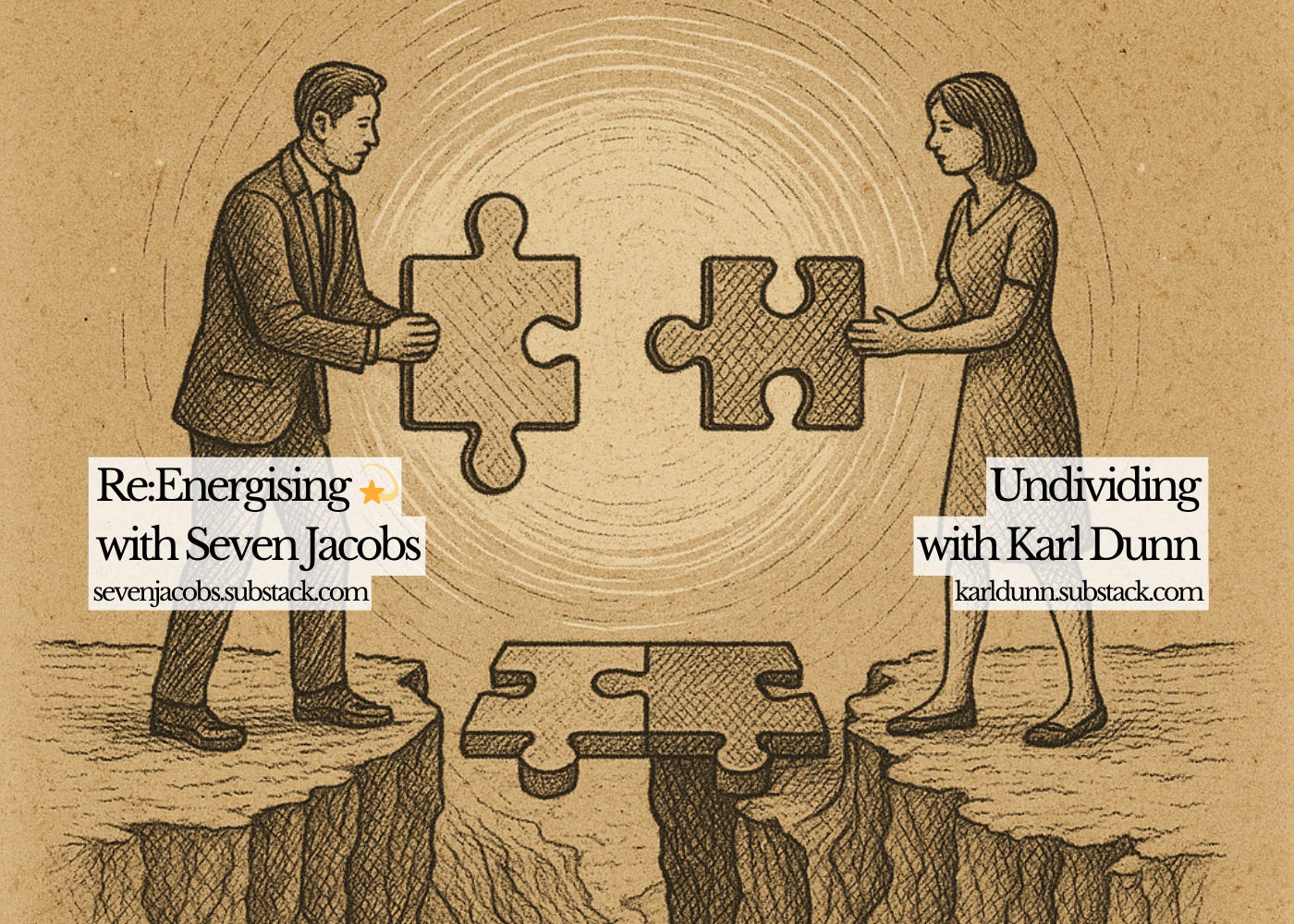
To tackle this today, I (Seven Jacobs, writer of Re:Energising) wanted to team up with Karl Dunn, author and writer of the Undividing Substack, because he’s an expert and all around inspiration connecting the dots on all things to do with coming back together in a divided world.
(Seven’s writing will be in normal text, and Karl’s writing will be in bold and italicized text like this.)
Okay, so where are we going with this?
Our belief is that, in this exact same way, anything we take completely online becomes significantly harder to appreciate.
We began working from home more, and got comfortable with it.
That led to the most important underappreciation of all: that of human connection.
Just as the actual date is what counts, we’d argue the world of work is very similar. The meeting being taken from anywhere is useful, but the connection with that colleague or client is what truly matters.
Because our logical brain still thinks we’re getting that connection with the person we’re speaking with via Zoom or WhatsApp, we don’t try very hard to create real in-person connections. (And don’t appreciate that which we do have as much as we used to.)
Once a necessity, now this convenience called Work From Home (WFH) has removed so many points of human connection.
So, our world becomes increasingly divided, and from there, a cascade of effects follow.
Let’s get into it.
Re:Energising is a free reader-supported publication. I’m obsessed with bridging the gap between energy, psychology, and philosophy—all to help us cultivate more of who we really are. If you’re new, join the hundreds of other people who receive these weekly by subscribing.
Undividing is also a reader-supported publication. Learn more about Karl’s publication and support him here.
The Science
The psychological reasons for this are a mix of three things.
Loss aversion: This suggests that the pain of losing something is psychologically more powerful than the pleasure of gaining the same thing.
The endowment effect: Closely related, this refers to the tendency to overvalue things we own simply because we own them.
The limbic system: This is the “ancient brain”, which is the more base but naturally powerful part of our brain. It’s heavily involved in immediate, visceral reactions, which means it takes something physical (like a person or cash that you can touch) more seriously than something theoretical (like a phone number or a number on a banking screen).
Combined together, that “ancient brain” takes everything physical more seriously.
But of course, we’ve done the opposite.
Not just the opposite, the emptiest too.
I’m not saying that online connection doesn’t feel a real need in us. For a lot of folks out there in the world in this century, online connections with communities of people helps us realize we aren’t alone with a physical condition, a life stage, a sexuality, an incident.
Or just sharing ideas—case in point, Substack.
But we’ve massively overindexed on these relationships in the decade and starved ourselves of the IRL. This is what we are wired for, this is part of our DNA.
Which is why so many of us feel alone. The less we exercise those muscles of real life human interaction, the harder and more foreign it feels to do.
The Authority Bias
I once saw this post on LinkedIn. TLDR; it posed a question: “Why does location matter if employees deliver work without impacting quality and productivity?”
It argues people want WFH for reasons like:
Because their parents are aging.
Because they are parents to their only child.
Because they want to spend more hours with their wife than with stranger flatmates.
Because they want an afterlife with friends in their hometown.
Because they want to save money and invest rather than spend it all on survival.
Because they want to avoid getting stuck in traffic and attend meetings through the spare laptop.
And, that’s fair enough. But I’d argue we can also pose questions from a reverse perspective.
What about the people that want to come into a shared space because:
They’re a young person entering the workplace who is spending 40 hours a week all alone in a room - instead of making human connections - and feels incredibly lonely.
They aren’t a parent, don’t have a partner, are in a new country, or another reason why having people around them would be super important to them.
Someone wants to learn the ropes and get to know what it's actually like to work. I feel really bad for the young people who entered the workplace during COVID, who now might really struggle with professional etiquette, hindering career progression and effectiveness at the workplace (bad for the employer too!)
Making friends and enjoying time after work with colleagues-turned-friends is an important part of your day, social circle, and long-term interests.
Business results: some of us are much better at converting clients when we can build a genuine, non-transactional-because-it's-not-confined-to-a-square-on-a-screen, time.
In case it isn’t clear: 40 hours a week is a lot of time.
We used to know we’d be spending it surrounded by other people, and would therefore have a lot more time spent with other people, where we could build relationships, grow & learn, forge a community…
So unsurprisingly, I’d argue 40 hours less time every week spent with other human beings, probably in a box room of some kind, isn’t great for us. (Shocking, I know.)
For example, in 2023-25, it was estimated 11% of people meet their life partner at or through work. In 2016, that number was at 22%.
It’s halved in less than a decade. Yikes.
This is especially pertinent for younger people, where they haven’t yet built up the social circle that for many in their late 30s and 40s+ came, at least in part, from the workplace. (Again, 40 hours every week is a lot of time!!)
Case in point: I remember heading Steven Bartlett sharing a story (which other employers echo) that there are people who come into an interview, especially younger people in their 20s, who actively ask “Is this a company where people come into the office?”
They want to know if they’ll have the opportunity to potentially make friends.
Social connection is the cool new employee benefit no one realised they wanted, so being able to connect in person might genuinely affect whether they accept a job offer.
I’ve been working in offices for the better part of my life. And like Seven noted above, there is an etiquette, language, and customs of workplace life that you can only learn by entering the workplace physically.
Sharing spaces with other people you would never normally meet is also how you experience life and hear about the world from perspectives that are not your own. In my time I’ve done some of my best work with a gun carrying Republican in America, been to barbeques with workmates in Soweto, attended Ramadan with Moslem colleagues in Singapore, and struggled through a culture so entirely unlike my own in Japan.
Every single person has taught me new ways of seeing the world, its issues, and how we can solve them.
Most of the freelance work I still do is through the connections I made in the offices of the companies I worked for everywhere. It’s made me, me.
And I can tell you, no matter the country, you’ll get more done in one day in your clients office eating lunch, having meetings, and all the hallway chats than you’ll ever get done in a month of emails.
There are skills of negotiation, listening, compromising, and togetherness that I use everywhere in my life, but that I learned at work.
And while I’ve never dated anyone from the office, I’ve had many platonic work husbands/work wives!
I call this “The Authority Bias” because those with the authority make a mandate from top-down, forgetting what it’s like to be the person who has been impacted by that.
So, to come back to the question: “Why does location matter if employees deliver work without impacting quality and productivity?”
Because it does impact quality and productivity.
Let’s ignore for now that “productivity” is an unhelpful word - a term coined in a bygone area (the industrial revolution) that isn’t particularly useful anymore.
Without at least some consistent in-person time spent, you’ll get:
Reduced human connection (bad for the employee and for the world)
Reduced creativity (bad for the employer)
Reduced effectiveness of a culture (bad for the employer)
Reduced growth of younger employees (bad for the employer)
Simple example: Are you feeling down because you’re lonely? Best believe it’ll bleed into your work.
We must find a way to strike a balance between flexibility and creating consistent genuine human connection.
I love the freedom of working from wherever I want to. Thank you Zoom, Slack, and email. Living this way is a privilege and a gift.
But there’s something amazing about just going to the office. The chance to connect, and feel the most important two things about work:
1. Ownership - when the job is right in front of you on a table with other folks, you feel like part of it is yours. Like what you’re doing matters. Like you want to not just see it through, but do it for the team. So you put your best into it. You spend your time thinking how can I make this better, not what’s the minimum I need to phone in. It usually is the same amount of time spent. One fuels you, the other drains you.
Too much remote life feels like you’re chopping vegetables for a kitchen you’ll never cook in, or see a final dish come out of. So who cares?
2. Teamwork - A big part of working with a team of people is seeing how each person does their thing in front of you. That’s when I see someone’s super power. That’s when I see what they do that no one else can. That’s the part of the job that I defer to them over. And I can tell you that people love being seen, appreciated, and understood. That’s a real life phenomena. And when we all do our best work - because it feels like it matters.
A balance of both remote and in office has always felt like the right recipe to me. And with distinct separations so that like Seven said, there’s work and there’s life. Not a 24/7 work/life.
What this ultimately comes down to: The P Word
Privilege.
If you’re privileged enough to:
Already be quite experienced or otherwise well ahead on your career trajectory
Have already met your life partner, had your kids, or whatever else your personal life goals were
Already have your in-person community
Then needing to be on a sweaty train to have meetings that could have been emails, and probably seeing your kids less as a result, can seem like a total waste.
I get it.
But there’s harmony in everything.
I also want to be aware of agendas: a lot of the bigger companies that forced everyone back into the office 5 days a week went too far.
In fact, there was also a theory floating around the internet that the reason big companies were bringing everyone back to the office is in the hopes that they quit, because they wanted to reduce workforce in the run-up to AI replacing their jobs so they wouldn’t have to pay severance packages. (Can’t find sources now so take with a pinch of salt.)
So I’m not suggesting we need to only ever work together in person. Flexibility is great.
But my point is this:
If you’re going to stand on the pedestal of “you don’t understand what it’s like to be me” to justify being fully remote/WFH, and leave out those that actually quite need that human connection, then at best, you’re being hypocritical.
At worst, you’re actively contributing to further division.
Because it suggests you have forgotten what it means to have been in that position, of needing that connection, that experience.
One of the greatest things you’ll ever feel is when someone you worked with reaches out to you for advice. You discover in one conversation that the office relationship you had with them meant so much more than you ever could have imagined.
Or when someone refers you on to a job because, “you’re a great person to work with.”
Yes, there’s a lot of companies who demand that we be back at our desks for the wrong reasons. And my goodness, reply-all goes down for me as the second worst invention after the like button.
And yes, many people have lives and responsibilities that a 9 to 5 doesn't allow. I get that too.
But I can tell you after 30 years in corporate, there are people at the office who aren’t your bosses whose best part of the day is when you walk through the door.
We’re so worried in our world, rightly so, about challenges like rising suicide rates, declining birth rates, greater anxiety, siloed thinking and division, on and on.
Great news though: the antidote to all of these things comes in one simple package: to be human beings, together, in person, once more.
Simple doesn’t mean easy, I understand that.
But we need to find a balance proactively. Not reactively.
Just like with dating apps, and so many more examples, this ‘nice-to-have’ has now become the norm. And by being the norm, as opposed to an extra nice to have, these deep and widespread unintended consequences have done more damage than good.
We need to turn the tables and treat it as a ‘nice-to-have’, prioritising human connection, in person, once again.
Lots of love and here’s to your success! - Seven and Karl
About us
Karl is a writer creating for people who look around the world, see the divisions everywhere, and want to do something about it. You can find his Substack and archive here.
Seven is a writer exploring how we re-energise in a noisy world, so we can discover and cultivate the leader we were all always meant to be more of. You can find him on socials here.
 | A guest post by
|
A one size fits all model is problematic as humans have our very own circumstances and preferences. For instance, many disabled individuals have preferred wfh as they are able to adjust their work conditions to suit their disability and don’t have to subject themselves to pain and inconvenience of commuting. Yet companies mandating return to work rarely take this into account. A degree of individual choice has to be built into the solution.
Comparing remote work to dating apps, claiming both strip away the human element, leaving wasted time, disappointment, and disconnection is a catchy analogy, but it feels more like a disingenuous effort to justify Return to Office (RTO) mandates than a genuine critique of remote work.
The real driver behind RTO isn’t social well-being or productivity, it’s real estate and the loss of profit. Companies invested heavily in office space and now face losses as those spaces sit empty. For decades, work-life balance has been sacrificed for profit, and this is no different. The office-centric model has been outdated since the internet made meetings, collaboration, and communication possible from anywhere. Many businesses are paying for space they don’t need, and probably haven’t needed for years. Forcing employees back simply shifts the cost of bad investment decisions onto workers.
Of course, WFH has challenges. It reduces casual mentorship, hallway chats, and can bring isolation. Additionally, surveys show people with close friends at work are happier, but should the office really be our primary source of connection? Would those surveys show the same result if we had those connections outside of work? To blame remote work for fraying social ties ignores bigger forces such as social media, economic stress, and changing family dynamics. And ironically, RTO often adds stress. Commutes, higher costs, and less family time all undermine productivity and increase stress on workers.
Moreover, why should work bear the weight of being our main social hub? For most of human history, people worked remotely on farms, in workshops, in homes, and found social life in their communities, churches, neighborhoods, sports, volunteering, and family. Remote work didn’t create disconnection; it revealed how much we’ve outsourced social life to the office. Bonds at work can be valuable, but true connection thrives outside office walls, where we know each other as whole people.
When companies treat the office as the center of human connection, they blur the line between professional and personal life in ways that drain rather than enrich. Work should build collaboration and trust, not replace genuine social interaction. Instead of calling WFH the problem, businesses should own up to their failure to adapt. Imagine if unused offices were converted into housing, a big step toward solving the housing crisis while acknowledging the shift in how we work.
The answer isn’t to force people back into cubicles. It’s to design healthier, more flexible work models that blend intentional collaboration with freedom, allowing people to build strong, meaningful communities beyond the workplace.